Sign in. It’s quick, free and it’s up to you.
An account is an optional way to support the work we do. Find out more.
Sign in. It’s quick, free and it’s up to you.
An account is an optional way to support the work we do. Find out more.

THE GOVERNMENT’S PLAN to overhaul how Ireland sends troops overseas has dominated Dáil debates in recent weeks, with both sides trading sharp accusations over what the changes mean in practice.
Under the current “Triple Lock” system, deploying more than 12 members of the Defence Forces abroad requires the approval of the government, a Dáil vote and a United Nations mandate.
The government has planned to scrap the UN mandate under the Defence (Amendment) Bill 2026, something that has proved contentious in the context of Ireland’s military neutrality.
Opposition TDs and neutrality campaigners warn the move will undermine Ireland’s military neutrality, break past referendum assurances and open the door to deployments without UN backing.
Both sides have accused each other of spreading “misinformation” about the removal of the Triple Lock, with a string of contested claims across the political divide in recent months.
We’ve looked at five claims that feature heavily in the ongoing debate, and sifted through the facts.
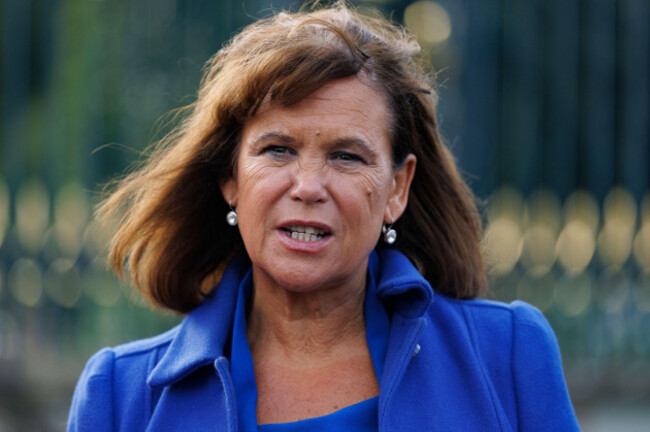
Sinn Féin leader Mary Lou McDonald challenged the government on what the removal of UN authorisation for peacekeeping missions would mean.
Speaking during Leaders’ Questions on 10 November, she said that the deployment of Irish troops on UN missions would no longer be considered peacekeeping if there was no such mandate.
“Just so the Minister knows, peacekeeping missions by definition require a UN mandate,” she said.
“In the absence of a UN mandate, it is no longer a peacekeeping mission. It is actually as simple as that.”
However, there’s a distinction between what Irish legislation says about sending troops abroad and international definitions of peacekeeping missions.
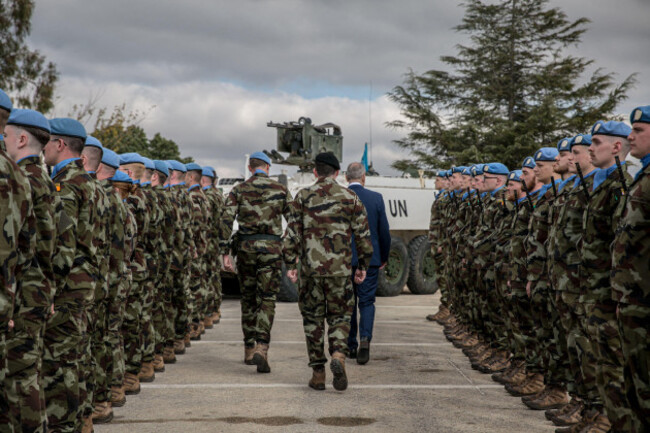
In an Irish context, the concept of peacekeeping is set out in the Defence (Amendment) Act 2006, the legislation that allows members of the Defence Forces to be sent overseas, with specific reference to UN missions.
That UN-specific framing dates back to the Defence (Amendment) (No. 2) Act 1960, which passed to create an exception to the Defence Act 1954 that restricted military service to inside the State.
It meant Ireland could join UN peacekeeping missions in the Congo, and was retained in 2006 when the law was updated to cover UN-backed missions led by regional bodies like the European Union.
The legislation refers to troops taking part in an “International United Nations Force”, defined as a mission that is “established, mandated, authorised, endorsed, supported, approved or otherwise sanctioned” by the UN Security Council or General Assembly.
However, UN resolutions are not universally required for peacekeeping missions.
One example is the Multinational Force and Observers, a group that monitors security arrangements under the 1979 peace treaty agreed between Egypt and Israel.
The organisation was established through an agreement between those countries in 1981, after it proved impossible to secure Security Council approval for a UN force.
It operates outside the UN framework and describes its role as international peacekeeping, and with troops deployed from places like the US, Canada, Australia, New Zealand, Fiji, Japan, the UK, Czechia, Norway, Italy, Albania, Serbia, Colombia and Uruguay.
The distinction between Irish legislation and international definitions is also addressed in a briefing on the Triple Lock legislation by the Oireachtas Library and Research Service.
It explains that regional organisations can conduct peacekeeping with the consent of the host states, without express Security Council approval.
That doesn’t mean that regional organisations can undertake any military operation without UN authorisation.
Chapter VIII of the UN Charter distinguishes peaceful regional action from enforcement action, for which Article 53 requires Security Council authorisation.
But McDonald’s statement treats an Irish deployment requirement as a definition applying to all peacekeeping.
She claimed that peacekeeping missions by definition require a UN mandate, but the existence of peacekeeping operations outside the UN framework contradicts that definition.
We therefore rate her claim: FALSE. As per our verdict guide, this means the claim is inaccurate.
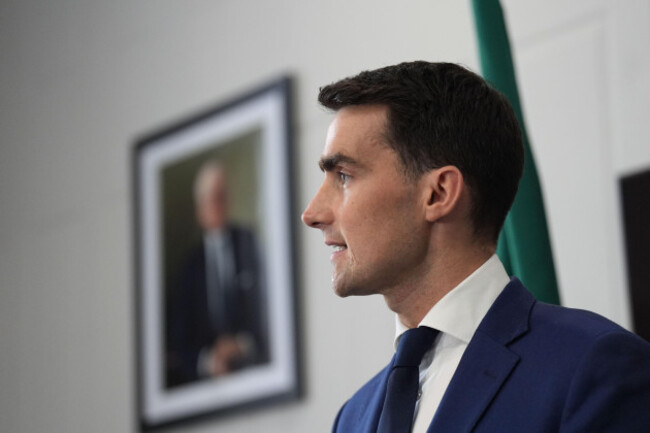
In the same Dáil debate, finance minister Jack Chambers argued that the government’s legislation is needed if Ireland wants to participate in peacekeeping missions at all.
“Without the reform we are proposing, Ireland will no longer have the capacity in many instances to participate in peacekeeping around the world,” he said, responding directly to the Sinn Féin leader.
“The Government will not allow Russia, China, Britain, the US or anyone else to have a veto over our independent foreign and security policy.”
Chambers’s argument combines an existing legal constraint with a prediction about Ireland’s future peacekeeping opportunities.
The claim about other countries having a veto on Ireland’s troop deployments has been a central pillar of the government’s explanation for wanting to remove the Triple Lock.
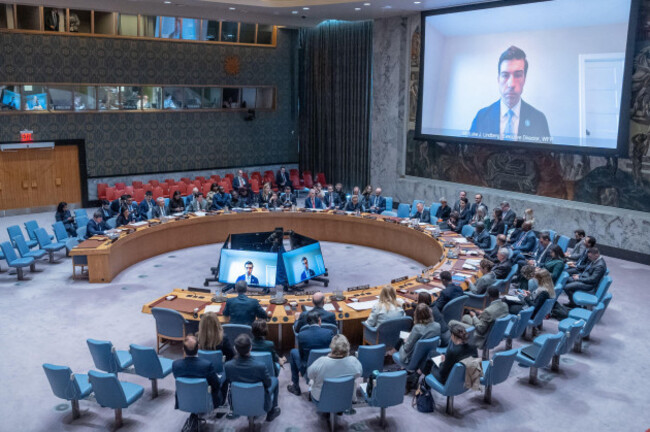
The Security Council’s five permanent members, the four countries named by Chambers plus France, each hold a veto over substantive resolutions.
This can obstruct the authorisation or renewal of a mission on which Irish participation depends, because under current legislation, troops can only be sent on missions that have a UN mandate.
However, the permanent members of the Security Council do not have to vote in favour for a resolution to pass.
The Security Council’s explanation of its voting system notes that abstention does not constitute a veto.
Nor is the Security Council the only route recognised in Irish law.
As mentioned in our analysis of McDonald’s claim, Section 1 of the 2006 Act also recognises a qualifying resolution of the UN’s General Assembly.
There, each country has one vote and nobody has the Security Council’s permanent-member veto.
And this alternative has a historical precedent.
The General Assembly established the first UN Emergency Force in 1956 through the Uniting for Peace mechanism, a resolution that allows the assembly to address threats to international peace and security when the Security Council is deadlocked.
It doesn’t mean that an equivalent arrangement would be available for every future mission, but it does show that the UN Security Council is not the only route towards peacekeeping.
That being said, that was the first and only time the UN General Assembly approved such a mission.
Section 3 of the 2006 Act also says that Irish troops can serve overseas if it involves training, monitoring, observation or humanitarian responses to disasters or emergencies.
These are separate powers, rather than a blanket exemption that allows participation in any international force, but it’s again noteworthy that Defence Forces members can still do important, peaceful work overseas without UN authorisation.
Chambers and the government have identified a real constraint involving the Security Council and its veto, which can restrict Irish participation in some missions.
The minister said that without removing the Triple Lock, Ireland will no longer have the capacity to participate in peacekeeping missions.
Ultimately, the Security Council veto doesn’t give members a decision on every overseas deployment or even sending peacekeepers abroad.
In practice though, the UN has only approved one peacekeeping mission outside the Security Council in its history.
We therefore rate the minister’s claim: MIXTURE. As per our verdict guide, this means there are elements of truth in the claim, but also elements of falsehood. Or, the best available evidence is evenly weighted in support of, and against, the claim.
Throughout the ongoing debates on removing the Triple Lock, opposition TDs and parties have called on the government to hold a referendum on the issue.
They frequently cite opinion polls, such as one carried out by the Irish Times last year, that show a plurality of voters would prefer to keep the mechanism in place.
However, the government has repeatedly dismissed those calls by saying it’s not the kind of issue that merits a referendum.
In another edition of Leaders’ Questions on 17 November, Taoiseach Micheál Martin said that Ireland has never had a referendum that isn’t about the constitution.
“We are not Switzerland; we do not have referendums on issues per se where we are not adding to, removing from or amending the Constitution. That is a clear point,” he said.
Martin’s point is historically accurate: Ireland has had 43 referendums since the foundation of the State in 1937, and every single one of them has been a constitutional referendum.
But that doesn’t mean we can only hold referendums on the Constitution.
Irish law says we can have what is known as an “ordinary referendum” under Articles 27 and 47 of the Constitution, though it’s a restricted procedure.
Under Article 27, certain bills of major national importance can be put to the people in an ordinary referendum.
That requires a majority of senators and at least a third of TDs to jointly petition the President about the relevant bill, who must then consult the Council of State on the issue.
The President must then decide whether the proposal is sufficiently important to require a decision of the people.
This mechanism has never been used in practice, and earlier this month, there was a plan by a cross-party group of TDs and senators calling themselves the Put It To the People campaign to apply this to the Triple Lock legislation.

However, the group never got off the ground because an ordinary referendum can only be called in very specific circumstances that may not apply in this case.
Article 27 says the president can only be petitioned for bills “which shall have been deemed, by virtue of Article 23 hereof, to have been passed by both Houses of the Oireachtas”.
But it applies only where the Dáil has used Article 23 to pass a Bill that the Seanad has rejected (which has only happened twice before).
To make a long story short, it’s unlikely the Triple Lock legislation will get to be put to an ordinary referendum.
In response to queries from The Journal, a spokesperson for the Taoiseach said that there is a “long-established position” that referendums have been used to amend the Constitution and that matters of policy and legislation “are for the government and the Oireachtas”.
“It is fully accepted that provision is made at Article 27 of the Constitution for the reference of Bills to the people in the very specific and limited circumstances set out,” they said.
“No such reference has ever been made.”
The spokesperson added that the proposals put down in the Triple Lock legislation are a matter for the government in accordance with Article 28 of the Constitution.
Micheál Martin is right that Ireland doesn’t vote in non-constitutional referendums, because we’ve never had the chance to do so, though any implication that we can’t do so is not technically accurate.
We therefore rate the Taoiseach’s claim as: MOSTLY TRUE. As per our verdict guide, this means the claim is close to accurate, but is missing significant details or context.
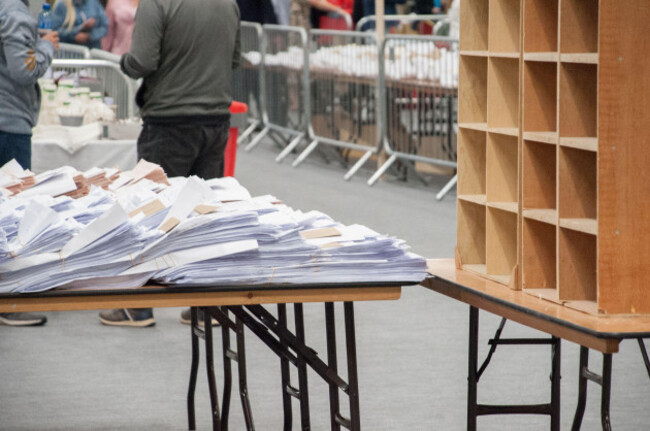
Another opposition talking point relates to Ireland’s double referendums on the Nice Treaty and Lisbon Treaty in the 2000s.
Both treaties – which were essentially about how the European Union functions – were initially rejected and featured arguments about Ireland’s neutrality and defence before they were later passed at the second time of asking.
In a Dáil debate about the Triple Lock on 21 October, Sinn Féin TD Conor D. McGuinness riffed on the referendum issue by invoking the two treaties.
“At Nice and Lisbon, the people were asked to vote with guarantees of neutrality, including the triple lock,” he said.
“Now, the Government wants to remove that safeguard without asking the people.”
There is documentary evidence that the Triple Lock formed part of the assurances surrounding the second referendums on both the Lisbon and Nice treaties.
Before the second Nice referendum in 2002, Ireland issued a national declaration at the Seville European Council.
Paragraph six expressly restated the Triple Lock requirements for troop deployment: UN authorisation, government agreement and Dáil approval.
The declaration also stated that the position it described would be unaffected by the Nice Treaty taking effect.
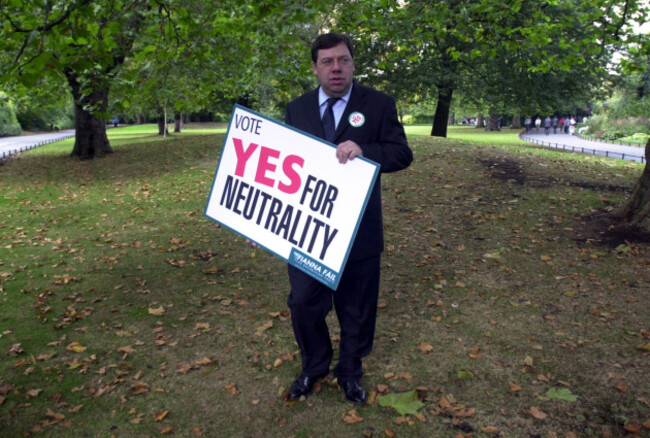
The requirements were restated before the second Lisbon referendum in 2009.
The Referendum Commission’s extended guide on the vote, in pages 22–23, explained Ireland’s declaration on military neutrality and listed the three approvals.
However, it treated that Irish declaration separately from the European Council decision containing legally binding assurances about the treaty’s effects.
An Oireachtas research briefing on the Triple Lock legislation from last year states that the subsequent Irish Protocol to the Lisbon Treaty did not expressly incorporate the mechanism.
However, McGuinness’s quoted statement is about the assurances voters received, and documents from the time support his assertion.
We therefore rate his claim as: TRUE. As per our verdict guide, this means the claim is accurate.
Pretty much every molecule of oxygen in the debate around the government’s proposal has related to the Triple Lock, its removal and what impact that would have on Ireland’s policy of military neutrality.
The government have contributed to this themselves at times, with a social media post from Fine Gael earlier this month narrowing the discussion to a single issue.
“For Ireland to continue playing its role in international peacekeeping, as it has done for decades, we need to remove the Triple Lock. That’s all this legislation will do,” a post on X from 11 November said.
The post also featured a clip of party TD James Geoghegan appearing on RTÉ’s Leaders Questions programme on 11 November, where he talks about the legislation.
Removing UN authorisation for overseas missions is a central element of the Defence (Amendment) Bill 2026, but that is not the only thing the bill does.
Another section directly affects how a government can approve smaller deployments.
Under current law, the government can send up to 12 members of the Defence Forces to a qualifying international force without a Dáil resolution, subject to certain conditions.
However, the proposed legislation would increase that threshold to 50 troops.
As it stands, a new deployment of 30 Irish soldiers to an armed international force would require Dáil approval; but if the law passes, government approval on its own would suffice for the same number of troops to be sent on a mission.
The bill also contains provisions governing the suspension of Defence Forces members and the dismissal of officers in specified circumstances.
A spokesperson for the party said the social media post paraphrased Geoghegan when he appeared on RTÉ and communicated “the central policy objective” of the bill to remove the Triple Lock.
“The public and political debate surrounding this Bill has overwhelmingly concerned the Triple Lock and the proposed changes to it,” Fine Gael said in a statement.
“It would be unreasonable, when viewed in its proper context, to interpret [...] six words of social media copy as an assertion that the bill contains no other statutory amendments, including those relating to deployment thresholds or military disciplinary matters.”
The party also said that The Journal is a signatory of the International Fact-Checking Network (IFCN) and used this as an analogy to the situation with the United Nations.
“How would The Journal FactCheck feel if The Kremlin got a veto on the International Fact-Checking Network, and decided on which factchecks got published?” the statement concluded.
It should be noted that the IFCN has no say in the articles that its 170 plus members publish, so the analogy is flawed.
The increased threshold is a substantial omission from Fine Gael’s claim: even within the rules governing overseas deployments, the bill changes more than just the Triple Lock removal.
We therefore rate this claim as FALSE. As per our verdict guide, this means the claim is inaccurate.
The Journal’s FactCheck is a signatory to the International Fact-Checking Network’s Code of Principles. You can read it here. For information on how FactCheck works, what the verdicts mean, and how you can take part, check out our Reader’s Guide here. You can read about the team of editors and reporters who work on the factchecks here.

To embed this post, copy the code below on your site













have your say